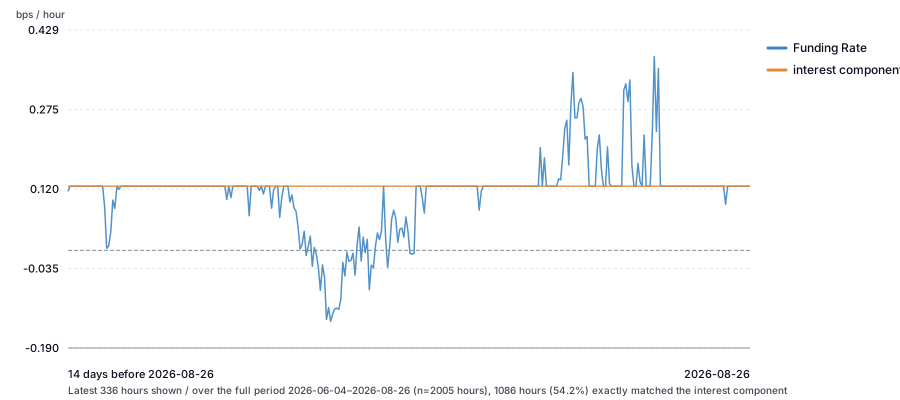
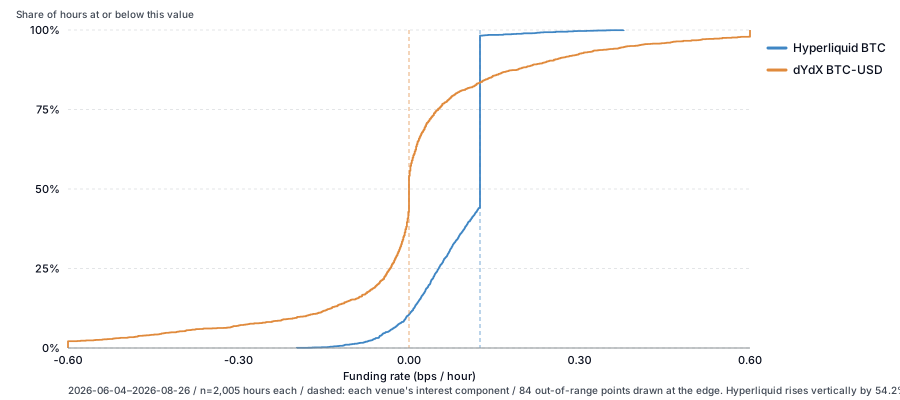
A funding rate combines a premium and an interest component joined by a clamp. While the premium stays in range, the output is just the interest component. Over 2,005 hours of Hyperliquid's BTC Perpetual, this held for 1,086 hours (54.2%), when the rate carried no supply-and-demand signal.
01A funding rate has two components, a premium and an interest component, joined by a truncation step called a clamp
02While the premium stays within a set range, the output is the interest component itself
03Over 2,005 hours of Hyperliquid's BTC Perpetual, the funding rate exactly matched the interest component in 1,086 hours (54.2%)
04During those hours the funding rate carries no information about supply and demand
05Checking whether the premium sits inside the clamp tells you whether an observed rate reflects supply and demand or an institutionally fixed constant
How this article defines the funding rate
The funding rate discussed here is the rate each venue applies and publishes at each funding settlement. Predicted values and annualized figures shown in exchange interfaces are out of scope.
Funding is not a fee the venue charges its users. In principle it is a transfer between longs and shorts. This article refers to the cycle of those payments as the funding interval.
This article deals only with how a single funding rate is determined. It does not compare levels across venues, annualize rates, or convert them into amounts paid.
The two components of a funding rate
Hyperliquid, Binance and OKX all publish formulas of the same shape.
Here impact_bid and impact_ask are not the best bid and ask. The official documentation defines them as the average execution price when filling impact_notional_usd: 20,000 USDC for BTC and ETH on Hyperliquid, and 6,000 USDC for other instruments.
In other words, the premium is calculated not from the top-of-book price but from the price at which a given size would actually fill. The idea of looking at execution prices rather than displayed prices is built into the formula itself.
dYdX v4 has the same structure but sizes the impact differently. It defines Impact Notional Amount = 500 USDC / initial margin fraction, which moves with the margin requirement rather than being fixed.
The reference price also differs by venue. Hyperliquid uses a weighted median of centralized-exchange spot prices computed by each validator, not its own order book.
The interest component, a constant set by the venue
The interest component is not set by the market. It is a constant chosen by the venue.
Venue
Interest component
Notes
Hyperliquid
0.01% / 8 hours (0.00125% / hour)
Paid in the direction that shorts receive
Binance
0.01% / settlement
Some contracts, such as ETHBTC, use 0%
OKX
0.01% (fixed)
Changed from a variable formula in the June 2026 revision
dYdX v4
0%
Default for cross markets
On dYdX v4, the interest component for cross markets is set to 0%. This is stated in the official documentation, and it leads to the difference in behaviour described below.
The premium cancels out, and only the interest component remains.
Within this range, the output does not change whatever the premium is. Only once the premium moves 0.05% or more away from the interest component does the clamp stop at its upper or lower bound, and the premium's value appears in the output.
Hyperliquid defines the formula on an 8-hour basis and allocates one eighth of it to each hourly rate. The premium range in which the clamp applies is therefore −4.0 bps to +6.0 bps on an 8-hour basis.
Each venue's public API (no authentication required)
Match criterion
Rounded to the published precision, with a tolerance of one unit in the last digit
The period starts on 4 June 2026 because OKX revised its formula on 1 June and had moved all contracts over by 4 June. A series spanning the revision would mix two calculation rules.
Binance is excluded from the analysis because its premiumIndex endpoint returns only the current value and the premium history is not published. Its specification is still referenced for comparison.
Share of hours in which the premium cancels out
Of Hyperliquid BTC's 2,005 hours, the funding rate exactly matched the interest component of 0.125 bps per hour in 1,086 hours, or 54.2%.
In those 1,086 hours, it made no difference to the output whether the premium was −4.0 bps or −0.5 bps. The clamp cancels the difference and leaves only the interest component.
For more than half of the observation period, the funding rate carried no information about supply and demand. Reading the state of the market from the level of the funding rate means interpreting hours in which there is nothing to read.
Where the clamp applies, and where the distribution actually sits
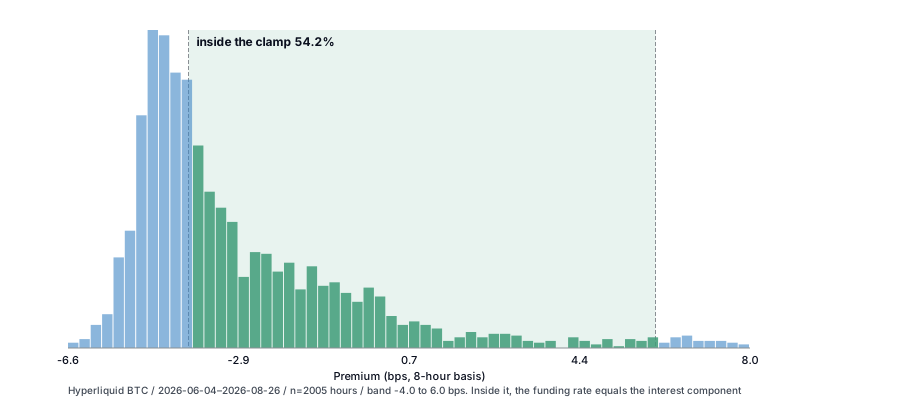
Overlaying the premium distribution on the clamp range shows where the 54.2% comes from.
Statistic
Premium (bps, 8-hour basis)
Relative to the band (−4.0 to +6.0)
Minimum
−6.579
Outside
10th percentile
−5.029
Outside
25th percentile
−4.582
Outside
Median
−3.779
Inside (0.22 from the lower edge)
75th percentile
−1.850
Inside
90th percentile
+0.183
Inside
Maximum
+8.023
Outside
The median of −3.779 bps lies inside the band, but only 0.22 bps from the lower edge of −4.0 bps. The 25th percentile is already outside.
Of the 919 hours outside the band, 884 were below the lower edge and 35 above the upper edge. The distribution is not symmetric; it leans towards the lower edge.
During the observation period, BTC sat at a point where a small move in the premium switched the output between "the interest component itself" and "a value reflecting supply and demand". This relationship changes with the instrument and the period. This analysis speaks only to the instrument and period covered.
Reproducing the formula from public data
Hyperliquid's funding rate history API returns the premium alongside the published funding rate. We substituted that value into the formula and checked whether it matched the published rate.
Group
Observations
Matched
Share
Inside the clamp
1,086
1,086
100%
Outside the clamp
919
919
100%
Total
2,005
2,005
100%
All 2,005 hours matched the published value. The median residual was 0 and the maximum 1×10⁻¹⁰.
The 1,086 hours inside the clamp coincide exactly with the 1,086 hours that matched the interest component. What happens inside the formula and what we observe in the published values are consistent.
This also means the formula can be verified from public information alone. Rather than simply receiving the funding rate a venue publishes, you can check what it was built from.
Contrast with a venue whose formula is structured differently
Whether the clamp and the interest component really matter becomes clear when you compare with a venue that has neither.
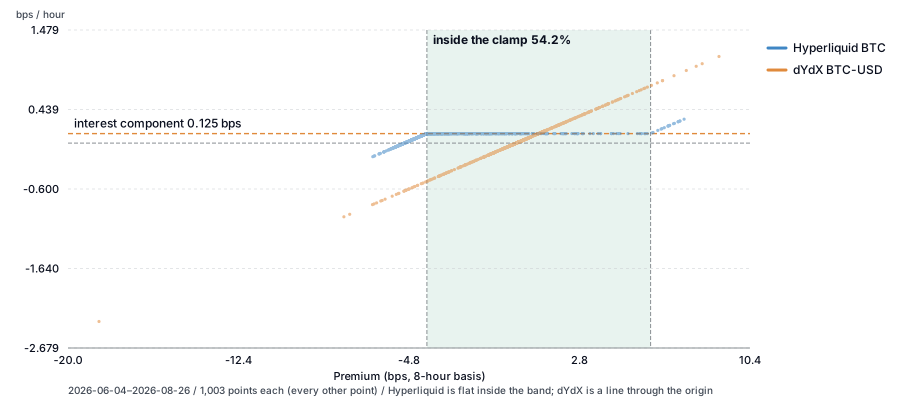
The dYdX v4 formula is:
Funding rate = premium / 8 + interest component
There is no clamp term. And the interest component for cross markets is 0%. The premium is output divided by eight, as it is.
Hyperliquid and dYdX both settle funding hourly, so the difference in formula structure can be isolated without mixing in a difference in funding interval.
Item
Hyperliquid BTC
dYdX BTC-USD
Funding interval
1 hour
1 hour
Interest component
0.125 bps / hour
0
Clamp
Yes (±0.05%)
No
Exactly equal to the interest component
1,086 hours (54.2%)
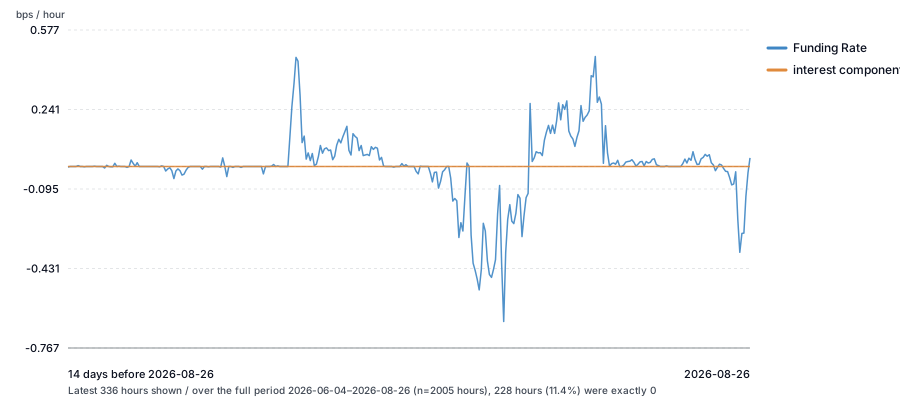
228 hours (11.4%)
Positive rate
1,794 hours (89.5%)
919 hours (45.8%)
Minimum
−0.197 bps
−2.333 bps
Maximum
+0.378 bps
+1.133 bps
Both cover 2,005 hours over the same period.
Because dYdX's formula has no interest component, its rate is zero only when the premium is zero. The 228 hours that equalled zero are not an institutionally fixed value. No pinning to a particular value was observed.
The share of positive rates is also a contrast. On Hyperliquid, 89.5% were positive. When the premium breaks below the lower edge of the clamp, the output becomes "premium + 0.05%", lifting downward moves by 0.05%. Indeed, against a minimum premium of −6.579 bps, the minimum funding rate was only −0.197 bps per hour. dYdX has no such lift, and its positive share of 45.8% was close to symmetric.
This is not a matter of high or low levels but of which terms the formula has. Comparing funding levels across venues is outside the scope of this article.
The premium is an average, not a point-in-time value
The premium that enters the formula is not the value at the moment of settlement. Each venue specifies that it samples over the funding interval and uses the average.
Venue
Sampling interval
Averaging method
Points per 8 hours
Hyperliquid
5 seconds
Simple average (over 1 hour)
720 points / hour
Binance
5 seconds
Time-weighted average
5,760 points
OKX
1 minute
Weighted moving average
480 points
dYdX v4
1 minute
Median aggregation, then averaged
480 points
The same word, "premium", is averaged differently on each venue. Binance uses a time-weighted average that gives more weight to later samples. dYdX takes the median of validator votes each minute and averages that over the hour.
Outliers are treated differently too. A simple average takes in a single outlier as it is, while median aggregation rejects it. Even with the same definition of the premium, a different aggregation method changes the output.
When the averaging method is not published
OKX describes its averaging only as a "weighted moving average" and does not publish the weights.
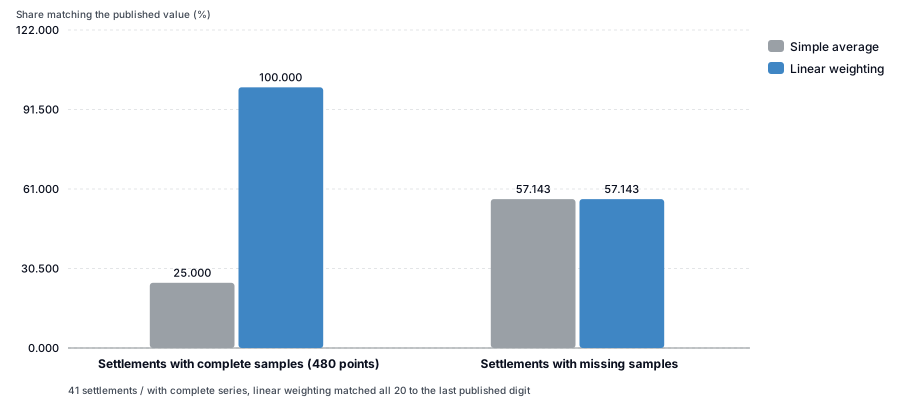
OKX's public API provides a premium series in 60-second steps. We averaged it in two ways and compared the results with the published funding rate.
Averaging method
All 41 settlements
20 settlements with all 480 samples
Simple average
17 (41.5%)
5 (25.0%)
Linear weighting (1, 2, …, n)
32 (78.0%)
20 (100%)
For settlements with all 480 samples, linear weighting matched the published value to the last digit in all 20 cases. The median residual was 0 bps and the maximum 0.00353 bps. The 9 settlements that did not match all had missing samples (477 to 479 points).
Linear weighting has the same form as the time weighting that Binance publishes.
OKX does not publish its weights, however. This analysis does not confirm the specification; it shows only that the results are consistent with linear weighting. It does not rule out another weighting producing the same result.
Formulas get revised
Funding rate formulas are not fixed. Two revisions were announced in the past year.
Venue
Effective
Change
Binance
2025-09-18 08:01 UTC
Added a division by 8/N to the formula; at the same time changed the mark price moving average from 1 minute to 30 seconds
OKX
2026-06-01 (all contracts by 06-04)
Added a division by 8/N to the formula; changed the interest component from a variable formula to a fixed 0.01%
Both changes scale the per-settlement rate in proportion to the interval for contracts whose funding interval is not 8 hours. For 8-hour contracts there is no substantive change.
Aggregating across a revision date mixes two calculation rules in one series. When working with historical data, check whether the period includes a revision date.
Checking this in practice
Steps for deciding how to interpret an observed funding rate:
Check in the official documentation whether the venue's formula has a clamp term — its presence changes the behaviour
Check the interest component and the funding interval — some contracts use 0%
Calculate the premium range in which the clamp applies — interest component ± 0.05% (8-hour basis)
Check whether the funding rate equals the interest component — if it does, it carries no supply-and-demand information
Check whether the premium history is published — if not, the rate cannot be decomposed
Check whether the period includes a formula revision date — mixing rules breaks the aggregation
Do step 4 without rounding. A rounded comparison cannot tell values close to the interest component from values exactly equal to it.
The view from Futaba Lab Research
Some treat the funding rate as an indicator of supply and demand in the market. Our results show that this view holds in some hours and not in others.
For Hyperliquid BTC during the observation period, the funding rate was a constant for more than half of the time. However closely you follow it during those hours, you learn nothing about supply and demand. If you use it as an indicator, the first step is to check whether the indicator is moving at all.
More generally, a published formula means little just because it is published. Only when the inputs can be obtained from a public API does it become possible to verify the published values. That was possible for Hyperliquid and not for Binance. For OKX the weights were not published, but measurement narrowed down the candidates.
What a venue publishes, and what it does not, is itself part of market structure.
This article covers only how the components are built and does not compare venues. A comparison would require separate steps to align funding intervals and conversion methods.
Limitations of this analysis
Only one instrument, BTC, was covered. Other instruments differ in impact notional, margin requirements and caps, and the share of hours inside the clamp will differ too. The 54.2% figure here cannot be applied to other instruments.
The period is about 84 days. The 54.2% is an observation for this period, not a permanent property. If the premium distribution shifts, so will the share.
The OKX weights are an estimate. Linear weighting matched all 20 settlements, but OKX does not publish its weights and the specification has not been confirmed.
Because of the API's retention period, only 41 OKX settlements (20 with complete samples) could be evaluated — a small sample compared with Hyperliquid's 2,005 hours.
Binance is outside the decomposition. Its premium history is not published, so the same check could not be made.
This analysis cannot conclude:
What share of hours falls inside the clamp for other instruments or periods
What drives the difference between Hyperliquid's 54.2% and OKX's 10.8% (funding interval, impact notional and book depth were not examined)
Whether the wide spread of dYdX rates is due solely to the absence of a clamp
Whether the interest component reflects real funding costs
FAQ
Q. Can you tell in advance whether the premium is inside the clamp?
On venues that publish the current premium, you can check whether it is inside or outside right now. But the formula uses the average over the funding interval, not the value at settlement. Even if the current value is inside, the average may end up outside. Predicting this is outside the scope of this article.
Q. If the funding rate equals the interest component, does that mean the market is balanced?
No. A match means only that the premium is within 0.05% of the interest component. Imbalances moving within that range do not show up in the output. Having no imbalance and having an imbalance that is not reflected in the output are different things.
Q. What interest rate does the interest component represent?
Each venue simply sets it as a constant and does not state which rate it refers to. Hyperliquid describes 0.01% per 8 hours as 11.6% annualized, but the official documentation we referenced does not explain how that level was chosen. This article treats it as a constant set by the venue.
Q. Is the absence of a clamp on dYdX a design flaw?
This article does not evaluate that. Having a clamp or not changes behaviour, but which is preferable depends on the purpose. What we show is that a different formula structure produces different output in the same market conditions.
Q. Why are 8-hour and 1-hour figures mixed?
Because Hyperliquid defines the formula on an 8-hour basis and allocates one eighth of it to each hourly rate. The clamp range is specified on an 8-hour basis, so the premium distribution is shown on that basis too. The funding rate itself is an hourly value. To avoid confusion, this article states the unit each time.
Disclosures
Futaba Lab and its affiliates trade on their own account in digital asset markets. The analysis in this article concerns market structure within the scope of what can be disclosed, and does not represent the trading strategies, positions or execution terms of the company or its affiliates.
This article is provided for informational purposes and is not a recommendation to acquire or dispose of any financial instrument. Investment decisions are your own responsibility.
Measured on the BTC/JPY order books of three Japanese venues (bitbank / bitFlyer / Coincheck) over 48 hours. For a ¥100M market buy, the median gap from the best ask was 8.61–117.49bps; a 10× larger order raised it 5.82–21.95×. How far the public API can price also differs by venue.
Funding intervals differ by venue, so averaging the rates returned by each exchange API is not a comparison. Across four BTC Perpetual venues over 89.7 days, the spread between venue averages was 51.7x as reported and 9.4x once normalized to a 1-hour basis, and the ranking changed.
From 18 SEC filings and regulator publications. Whether the official holder record sits on-chain or with the transfer agent differs by issuer, yet in all three entities examined the issuer or its agent controlled changes to it. Where the record sits and who controls it must be checked separately.