Data and analysis conditions
| Item |
Detail |
| Entities |
Franklin Templeton (issuer) / Securitize (transfer agent) / Superstate (digital transfer agent) / SEC Division of Corporation Finance (regulator) |
| Documents |
Franklin Templeton Form 485BPOS (filed 27 July 2026) [1] / Securitize submission to the SEC Crypto Task Force (7 May 2025) [2] / Superstate's submission to the same (17 June 2025) [3] / SEC Statement on Tokenized Securities (28 January 2026) [4] |
| Primary sources |
18, all obtained from SEC EDGAR or SEC publications |
| Method |
Relevant passages extracted from the original text of each document and organized along the same 14 items |
| Out of scope |
Actual redemption times, tax treatment, treatment under Japanese regulation |
The entities were not selected by assets under management. They were selected so that their design philosophies on where the official record sits would differ.
Secondary sources are not used as the basis for any central claim.
Where the official record sits depends on the design
Entities take different positions on where the official holder record is kept.
Franklin Templeton's prospectus states that, for its tokenized money market fund, the transfer agent maintains the official record of ownership using a blockchain-integrated system [1]. The records within that system are described as being under the transfer agent's full control.
Securitize, by contrast, states in its submission to the SEC that the blockchain should be used as the primary ledger of ownership records by transfer agents, and that there is no need to keep a redundant off-chain copy [2]. It describes changes in ownership being registered by monitoring changes in wallet balances, without manual work or intervention by the transfer agent.
Superstate likewise takes the position that the blockchain is the primary record [3].
In its Statement on Tokenized Securities, the SEC describes an arrangement in which the issuer or its agent maintains the master securityholder file as an on-chain record, used together with off-chain records that link wallet addresses and quantities to holders' names and addresses [4].
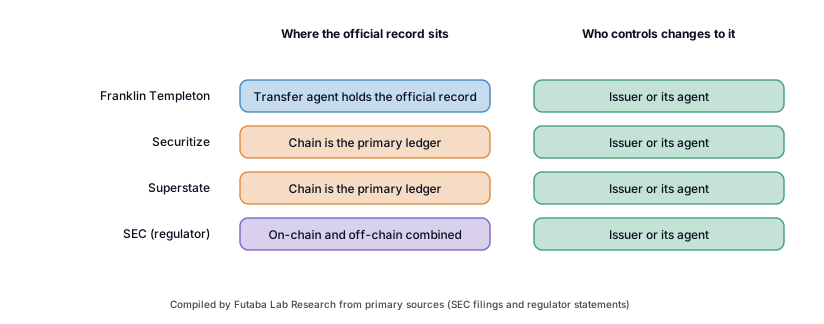
In other words, where the official record sits is not uniform. You cannot assume that "with tokenized RWAs, the record is on-chain".
Control lies in the same place for all three entities
While where the record sits differs, control over changing the record lay with the issuer or its agent in all three entities examined.
| Entity |
Where the record sits |
Who controls it |
Burn and reissue |
Freeze |
Transfer restrictions |
| Franklin Templeton |
Transfer agent holds the official record |
Transfer agent |
Not confirmed |
Not confirmed |
Yes |
| Securitize |
Chain is the primary ledger |
Issuer or its agent |
Yes |
Yes |
Yes |
| Superstate |
Chain is the primary ledger |
Digital transfer agent |
Yes |
Not confirmed |
Not confirmed |
Securitize states explicitly that tokenized securities are permissioned and not bearer instruments [2]. It describes mechanisms to control transfers, correct erroneous transfers and freeze assets for legal, regulatory and AML purposes. Tokens can be burned and reissued in response to erroneous or fraudulent transactions, and frozen in response to OFAC sanctions and the like.
Franklin Templeton's prospectus states that, unlike permissionless tokens, the fund's shares are under the transfer agent's unilateral control [1]. The transfer agent is described as able to correct errors and fraudulent transactions and to restrict transferability.
"Not confirmed" in the table means the original text does not mention it. It does not mean the capability does not exist. Franklin's prospectus describes the ability to make corrections and restrict transfers, but does not itself use the words burn and reissue, so we did not treat them as equivalent and marked it as not confirmed.
Advocates of putting records on-chain also accept the need for discretionary authority
The need for control is not argued only by those reluctant to move records on-chain.
In the same document in which it says an off-chain duplicate is unnecessary, Securitize writes the following about corporate actions [2]. Corporate actions such as mergers, spin-offs, dividends and stock splits require reliable administration so that investors receive accurate distributions. They can be automated with smart contracts to reduce manual work and cost. But real-world disputes, errors and regulatory requirements still need human involvement and discretionary authority.
Superstate also positions the digital transfer agent as performing the functions of a traditional transfer agent using smart contracts and blockchains [3]. It does not say that functions such as proxy voting and dividend payments themselves are replaced.
The case for automation and the recognition that discretionary authority is needed sit side by side in the same documents.
What happens after you hold
What administrative events actually arise depends on each product's terms. For Franklin Templeton's tokenized money market fund, the prospectus states the following [1].
| Event |
What the prospectus says |
| Income distribution |
An income dividend is declared daily from net investment income. Distributions are automatically reinvested |
| Accrual start |
From investments received by 2 p.m. Pacific time on a business day (or the time of the final NAV calculation that day, if earlier) |
| Redemption requests |
Via the App or the Institutional Web Portal |
| Redemption proceeds |
Electronic transfer to a bank account, within 7 days of receipt of a request in good order |
| Form of redemption |
No payment or receipt in cash or by cheque |
| Processing hours |
Only during normal business hours on business days |
| Transfers between holders |
A secondary market is not currently available, and may not become available |
The 7 days is a deadline stated in the prospectus, not a measured value. This article does not measure the distribution of actual redemption times.
What stands out is that while the record exists on a blockchain, money moves in and out by bank transfer and processing is limited to business hours on business days. Where the record sits and how the money moves are separate things.
On transfers between holders, the fund's prospectus states that there is currently no agreement for trading on a secondary market, that this function is not currently available and that it may never become available [1]. Being tokenized does not mean holders can transfer freely among themselves.
Redemption and transfer terms shape price formation
The terms above are not just administrative detail. They determine which price a holder actually realizes when turning the holding into cash.
For Franklin Templeton's tokenized money market fund, a secondary market between holders is not currently available, and the only exit is a redemption request to the issuer [1]. Requests are accepted during business hours on business days, and proceeds are sent to a bank account within 7 days. Under these terms, the price a holder can realize is the net asset value at redemption, and there is no continuously quoted market price.
In designs that allow transfers between holders or secondary trading, by contrast, a market price can form separately from the net asset value. Securitize refers to holders who choose self-custody making peer-to-peer transfers and redemptions and receiving distributions directly in their wallets [2].
Where several products are backed by the same underlying asset, different redemption and transfer terms may mean different prices that holders can actually realize. When a market price diverges from net asset value, the path to correcting it depends on whether redemption is practicable. If who you can redeem with, when and how quickly differ, the speed at which divergence closes differs too.
However, this is an inference from the terms stated in the documents; this analysis did not measure prices. We have not confirmed whether divergence actually occurs, or by how much.
What needs checking when valuing an asset is not only what the underlying is. It is also by which route, and how quickly, you can reach that underlying.
What happens if you lose your private key
Holder-side incidents are an issue specific to tokenized securities.
Superstate describes the procedure for a holder who loses access to their wallet [3]. The digital transfer agent verifies the holder's identity, burns the original tokens and issues new tokens to the holder. The company states explicitly that this procedure mirrors the current procedure by which transfer agents reissue lost securities.
Securitize also says that, given holders may lose private keys, mismanage wallets or be hacked, services equivalent to those a traditional transfer agent provides for lost securities are needed [2]. It lists whitelisting a new wallet, replacing keys and reissuing tokens.
If a holder loses their key, the point of contact for recovery is the transfer agent. That relationship does not change if the holder chooses self-custody.
Checking this in practice
When considering holding a tokenized RWA, there are six things to check in the issuer's documents.
- Where the official holder record sits — on-chain, with the transfer agent, or both
- Who has authority to change the record — the entity that can freeze, restrict transfers, and burn and reissue
- The form and route of income distributions — paid in cash or automatically reinvested
- Where to request redemption and during which hours — including cut-off times and the definition of a business day
- Whether transfers between holders are possible — whether a secondary market exists and is currently available
- The recovery procedure if a private key is lost — the point of contact and the proof required
Check 1 and 2 separately. Who has control cannot be inferred from the record being on-chain.
Items 4 and 5 also bear on valuation. Where and how quickly you can redeem, and whether holders can transfer among themselves, are the terms that determine the relationship between net asset value and the price you can realize.
The view from Futaba Lab Research
Discussion of tokenized RWAs often centres on market size and which companies are entering. For a holder, though, what is needed is information on who handles post-holding events, and through which route.
Within the scope of this analysis, even as the form of the record changes, the structure of who does the processing has not changed much from traditional securities. That the procedure for lost private keys mirrors the reissue of lost securities is one example.
At Futaba Lab Research, we analyse what actually happens after an asset is held, rather than the form the asset takes.
Limitations of this analysis
Three entities were covered. That is not enough to describe tokenized RWAs in general. What this article can say goes only as far as control lying in the same place in the three entities examined.
The documents differ in nature. Franklin Templeton's is a prospectus for an individual product; Securitize's and Superstate's are submissions to a regulator. It is natural that the submissions do not state an individual product's redemption terms, and "not confirmed" in the table does not indicate that a capability is absent.
Actual redemption times were not measured. The 7 days cited here is the deadline in the prospectus.
Prices were not measured. The statement that redemption and transfer terms shape price formation is an inference from the terms stated in the documents. We have not confirmed whether price differences actually arise between products backed by the same underlying asset, or by how much.
We could not confirm primary sources on who holds the claim if an issuer fails, and this article does not cover it.
The tax treatment of distributions is not covered. All the documents are from the United States, and treatment under Japanese regulation is out of scope.
Regulatory discussion in this area is ongoing. The statements in this article reflect the documents as of their publication and as of when they were obtained.
FAQ
Q. If the record is on a blockchain, is the holding protected if the issuer fails?
This analysis could not confirm that. We were unable to obtain primary sources showing who holds the claim on failure, so we cannot draw a conclusion. Where the record sits and who holds the rights on failure are separate questions.
Q. If I choose self-custody, is the transfer agent no longer involved?
Within the documents reviewed, the transfer agent's functions remain even if you choose self-custody. The transfer agent is the point of contact for recovering a lost private key, and who has control does not change with self-custody.
Q. Can you draw conclusions from just three entities?
Not as a general rule. This article shows only that "in the three entities examined, it was the same". The entities do, however, include ones with opposite positions on where the official record should sit. We think it is worth noting that control lay in the same place even between entities whose design philosophies conflict.
Q. Why not choose the issuers with the largest assets under management?
Because the point of this article is the difference in design philosophy. Lining up only entities with the same design could not test whether "the processing entity is the same even when the design differs". The entities were chosen so that their positions on where the official record sits would differ.
Disclosures
Futaba Lab and its affiliates trade on their own account in digital asset markets. The analysis in this article concerns market structure within the scope of what can be disclosed, and does not represent the trading strategies, positions or execution terms of the company or its affiliates.
This article is provided for informational purposes and is not a recommendation to acquire or dispose of any financial instrument. Investment decisions are your own responsibility.
